

Ever wonder how far your thumb travels in a year? With the average American spending 6 hours and 35 minutes a day on screens, adding up to 2,403 hours annually. It’s no surprise that we’re logging some serious scrolling mileage.
But this isn’t just about time spent staring at our phones. People check their devices an average of 58 times a day, with over half of those interruptions happening during work hours. Even more alarming? Half of those checks happen within just three minutes of the last, creating a nonstop loop of distraction.
This kind of constant task-switching isn’t just a harmless habit. It can slash productivity by as much as 40%. That got us thinking: if we’re spending this much time on our phones, how far are we actually scrolling each year? So, we ran the numbers and broke it down by state.
The results? Some states are racking up scrolling distances that rival actual road trips, and the productivity toll is just as eye-opening.
States That Scroll the Farthest Distances
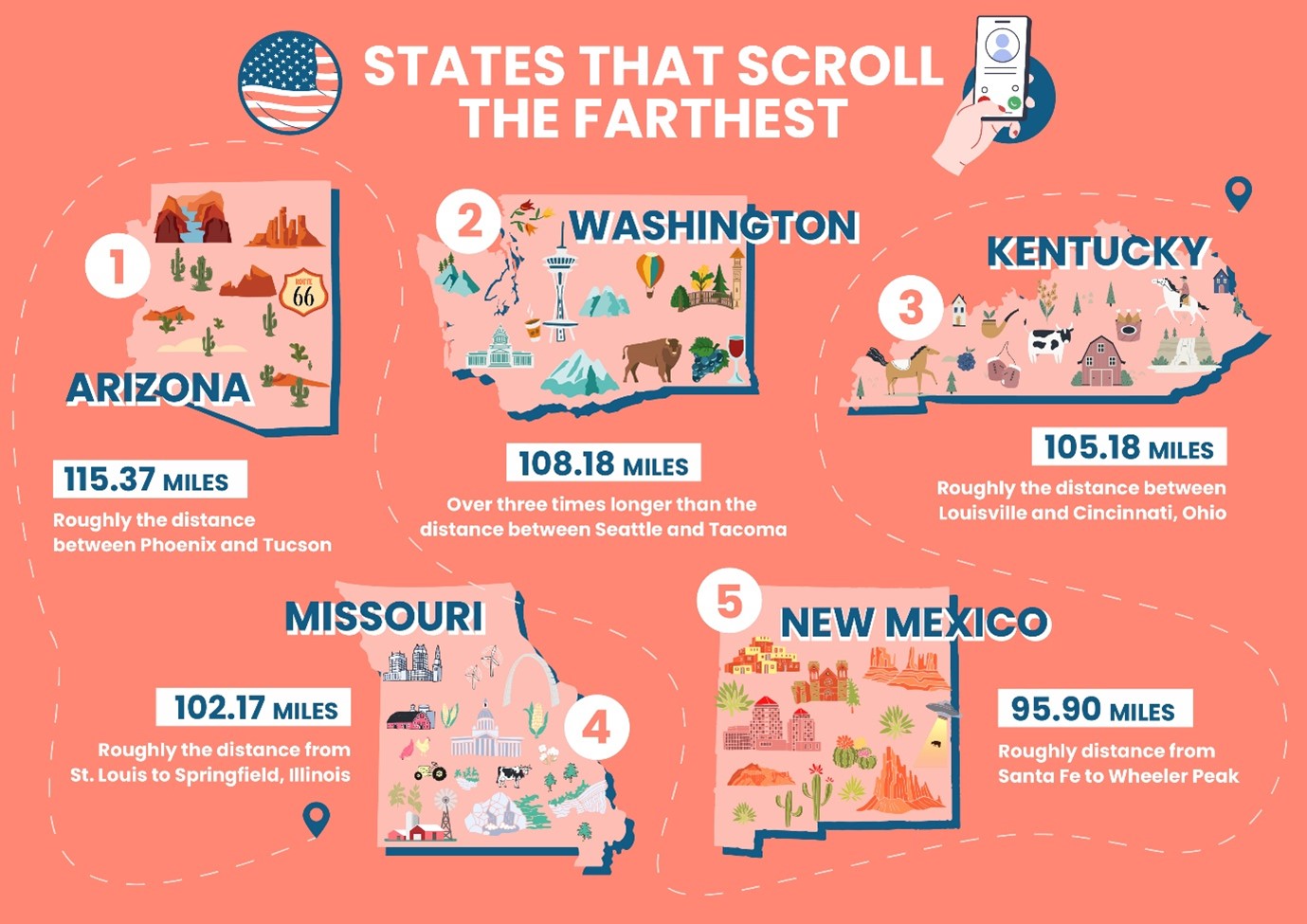
Arizona
Arizona tops the list with the highest average daily screen time in the country, an eye-opening 8 hours and 50 minutes per person each day. This massive amount of time spent on devices quickly adds up when it comes to scrolling. In fact, Arizonans scroll an estimated 115.37 miles annually on their phones. That’s roughly the same distance as traveling from Phoenix to Tucson. Imagine covering that distance just by swiping your thumb across your screen! This shows just how deeply integrated digital devices have become in everyday life across the state.
Washington
Washington isn’t far behind, with residents averaging 8 hours and 17 minutes of screen time each day. Over the course of a year, the scrolling distance in Washington reaches approximately 108.18 miles. To put that into perspective, it’s the equivalent of walking from Seattle to Olympia and back, all without ever leaving your couch. This staggering amount of screen time highlights how much of daily life in Washington revolves around digital interaction, from social media and news to entertainment and work.
Kentucky
In Kentucky, the average daily screen time clocks in at 8 hours and 3 minutes. That screen time translates to a yearly scrolling distance of about 105.18 miles, roughly the same distance between Louisville and Cincinnati, Ohio. Just by swiping through content on their phones, Kentuckians cover a distance that most would consider a notable road trip. This highlights how phone use is woven into everyday routines across the state, influencing how people consume information, communicate, and spend their leisure time.
Missouri
In Missouri, the average person spends an impressive 7 hours and 49 minutes a day glued to their screens. All that swiping and scrolling adds up. Over the course of a year, it equates to roughly 102.17 miles of scrolling with just your thumb. To put that into perspective, that’s about the same distance as a drive from St. Louis to Springfield, Illinois. Whether it’s social media, news, or endless notifications, Missourians are racking up serious digital mileage, and it’s a clear reminder of how much time and attention we’re devoting to our devices.
New Mexico
In New Mexico, residents spend an average of 7 hours and 20 minutes each day on their screens. Over the span of a year, that screen time adds up to approximately 95.90 miles of scrolling. To visualize it, that’s about the distance from Santa Fe to Wheeler Peak, the highest point in the state. Whether it’s texting, browsing, or watching videos, New Mexicans are covering nearly a hundred miles with their thumbs alone, highlighting just how embedded screens have become in daily life.
The Top 10
| State | Average Daily Screen Time | Scrolling Miles Per Year |
| 1. Arizona | 8h 50m | 115.37 |
| 2. Washington | 8h 17m | 108.18 |
| 3. Kentucky | 8h 3m | 105.18 |
| 4. Missouri | 7h 49m | 102.17 |
| 5. New Mexico | 7h 20m | 95.90 |
| 6. Texas | 7h 19m | 95.77 |
| 7. Maryland | 7h 14m | 94.59 |
| 8. Louisiana | 7h 9m | 93.42 |
| 9. South Carolina | 7h 6m | 92.76 |
| 10. Georgia | 6h 58m | 91.07 |
The Cost of Lost Productivity
Wasted productivity costs the global economy an estimated $8.8 trillion each year, and a major culprit behind this staggering figure is excessive phone use. Constant notifications, endless scrolling, and frequent task-switching chip away at our focus and efficiency. In fact, studies show that excessive phone use can reduce productivity by as much as 40 percent. For businesses, this means lost hours, lower output, and a serious hit to performance across teams. As phones continue to blur the line between work and distraction, the financial impact of screen time is becoming impossible to ignore.
How to Reduce Screen Time
As the financial toll of screen time continues to grow, there are practical steps you can take to reclaim lost time from your devices. Some of the most effective strategies include:
- Set specific time limits for daily screen use using built-in device tools or apps.
- Schedule regular breaks using techniques like the Pomodoro method (e.g., 25 minutes work, 5 minutes break).
- Turn off non-essential notifications to minimize distractions.
- Designate “screen-free” zones or times, especially during meals and before bed.
- Use website blockers or focus apps to limit access to distracting sites during work hours.
- Replace some screen time with offline activities like reading, exercise, or hobbies.
- Keep your phone out of reach or in another room while working on important tasks.
- Prioritize tasks with a to-do list to stay focused and reduce mindless scrolling.
- Use grayscale mode on your phone to make it less visually appealing.
- Practice mindful use by checking your screen only when necessary, not out of habit.
Turning Scroll Time into Focus Time
Our scrolling habits may seem harmless on the surface, but as this data shows, they add up fast—in both miles and lost productivity. From Arizona to Georgia, people are covering the distance of entire road trips each year with just their thumbs. And with that much time spent on screens, businesses face real consequences. The constant interruptions and task-switching fueled by phone use are quietly draining focus, efficiency, and billions of dollars in potential output.
At TollFreeForwarding.com, we understand the value of productivity and clear communication. Our virtual phone numbers are designed to streamline business calls and reduce distractions, helping teams stay focused on what matters. By becoming more mindful of screen time and using smarter communication tools, both individuals and businesses can cut down on digital clutter and get more done with less scroll.
Sources
https://medium.com/@abdul.rehman_84899/the-impact-of-screen-time-on-work-productivity-5334212682c5
https://www.hostingadvice.com/studies/screen-time-survey-2024/
https://www.sbam.org/unhappy-workers-cost-1-9-trillion-in-lost-productivity/
Methodology
Distances were calculated by converting the average screen time in every state into seconds. This figure was then multiplied by 6.3 (length of an iPhone 16 Pro Screen) over 10 (frequency of a scroll, in seconds), resulting in the distance traveled in inches per day. The resulting figure was then divided by 12 to get the distance in feet per day. The figure was then divided by 5280 to get the distance in miles per day and then multiplied by 365 to get the final figure.