CALL 1-888-452-1505Outside USA?

Tag Archive: Careers

8 Steps to Deal with Tricky Customer Calls

Written by TollFreeForwarding.com | 


If you’ve ever worked in a customer-facing role, you know it’s not all smooth sailing. No matter how much you want or try to help a customer, there are still other obstacles preventing you from doing so. Whether the obstacles are because of company policy, individual circumstances, or even the stubbornness of a customer, there are ways you can deal with these situations. With the help of select business, HR, and anger management experts, we’ve put together our eight top tips for dealing with tricky customer calls.


1. Look after yourself first
Before you start worrying about anything to do with your job, you have to make sure you’re looking after yourself. A call center, in particular, can be a very stressful work environment, and it pays to make sure you can detach yourself from it in your home life. Anger Management Specialist at Mind and Power, Eileen Lichtenstein, believes plenty of rest and a healthy dose of mindfulness can help:
“Sleep is important – you should have 7 hours at least. It can be helpful to relax before sleep without devices. Focus on deep breathing and clearing the mind and/or positive visualizations. If you’re too agitated to do this, doing a progressive muscle relaxation is helpful to release muscle tension and prepare the body to relax.”


2. Be prepared
As much as you have a responsibility to make sure you’re ready for the job, your employer also has certain responsibilities to make sure you’re prepared for any potentially difficult situations. Business Consultant at S and E Consulting, Armando Alcaraz, explains what you should expect from your company:
“Make sure you have clear guidelines and company policies. You can also ask for appropriate training and feedback on the job. Clarity of what you need to do or who you need to ask always makes the job easier and can reduce the stress that comes with it.”



3. Don’t take it personally
Never lose sight of the context of the situation you’re in. This is not a personal phone call, and if you do have to deal with a difficult customer, the first thing to remember is that none of this is personal. Remember the customer isn’t annoyed specifically at you, but rather at an experience they’ve had individually. Tish Squillaro, the author of the self-help book Mindtrash, explains how she rationalizes customer anger:
“One of the frustrations for everyone else who deals with an angry person is that you think you did something to create the anger. But here’s the secret. The anger was there from the beginning, and it keeps festering. In addition, sometimes angry people may have had their feelings pent up just waiting for something to set them off, and a simple thing that the call center worker said may have been the cause.”


4. Let them vent
Some customers just need to let it out. They will already have prepared an idea of what they want to say to get it off their chest no matter how you respond, so often it’s just best to let them get it off their chest. There’s no need to interrupt and antagonize them; just make sure you’re noting what their frustrations are so you can address them all after. Customer Experience Expert, Shep Hyken, agrees that you should simply listen:
“If a customer is complaining and angry, let them vent. Most likely they aren’t mad at you personally. Ask them questions to show that you care. Don’t add to their aggravation. You might ask them to repeat the problem just to make sure you understand. Be a good listener.”



5. Bring your call back to life with C.P.R
Sometimes when you’re in the midst of a tough situation all your training can get lost. So, keep it simple. If your phone call is in cardiac arrest, Gene Caballero, co-founder of GreenPal says just remember these three simple letters:
“I always use the C.P.R technique:
– Comprehend-what happened that made the customer upset
– Purpose-give the angry customer options on how to fix the situation
– React-once the actions have been agreed upon, react, and fix the problem. “



6. Be honest and assertive
Although you need to make sure you’re open and helpful, you also need to be assertive, especially with difficult customers. That doesn’t mean getting argumentative, but rather being clear on company policies and what you can do to help from the outset. If you start changing your mind or being unsure of yourself then the customer will sense your uncertainty. Eileen Lichtenstein expands on the importance of honesty:

“If you make a mistake on a call with a customer, it is important to admit the mistake and apologize to restore faith and confidence in you. Throughout a difficult conversation (in person or on the phone) it is important to stay in the assertive, friendly mode without being aggressive or defensive.”


7. Escalate it
If you don’t feel you can resolve the issue, then you may need to escalate the issue. Your manager is trained to deal with volatile customers and will probably have more experience. Use their experience to help both you and the customer if a situation has become too volatile. Director of Human Resources at Dupray, Pierre Tremblay, give his advice on escalation:
“It’s actually better to end the call as soon as possible to avoid escalation. The ramifications for failing to assist the customer will never outweigh the avoidance of inappropriate behavior. Escalate any information from the call to your supervisor and to HR, immediately and without hesitation. Keeping them aware of the situation will keep you out of trouble.”



8. Don’t put up with abuse

Some customers are just too difficult to handle, and you don’t need to put up with abuse. If a customer starts getting verbally abusive, let them know you will not continue the call if they continue acting in such a manner. Camille Charbonneau, Mental Performance Consultant at Peak Perform, believes the key in such situations is staying calm and professional:
“Don’t fight fire with fire. Fighting fire with fire will just get you worked up for nothing. Accept it and be non-judgmental to the correspondence. Be respectful and answer professionally otherwise you may get stressed for a silly reason.”
Doctors, Writers and eSports Players: How the Childhood Dream Job Has Evolved

Written by TollFreeForwarding.com | 


Fuelled by innocence and optimism in the initial phase of our lives, our childhood years are filled with aspirations of what we might become. Our dreams may be dominated by scoring the winning touchdown at the SuperBowl or leading your band out to headline at Coachella, but have the most popular childhood dream jobs changed over time?


Has technology impacted the younger generation’s idea of the dream job? To find out, we surveyed 2,000 adult Americans about their aims and ambitions when they were growing up, before finding out how many of them made it when it came to adulthood.


Generations Aspire for Public Service Roles

Respondents were asked, “What would you say was your dream job when you were a teenager?” The result touched on everything from creative, artistic roles, public-eye positions, and noble, caregiving jobs:


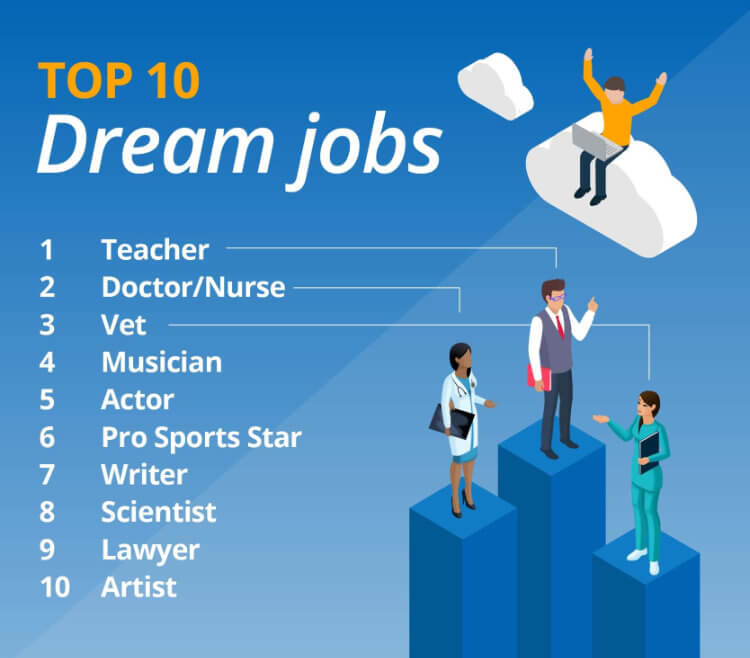
Top 10 dream jobs


These are the ten most dreamt about childhood jobs in today’s American workplace. Public service jobs performed particularly well, suggesting a strong sense of social responsibility in our teenage years. When broken down across five age brackets, the story is very similar.


A few interesting differences show that our idea of the dream job has evolved in some areas over the last 50 years.


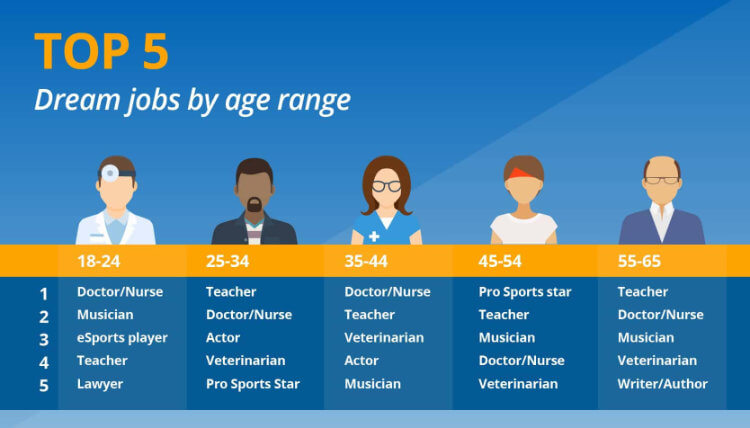
Dream jobs by age


Most notably is the emergence of “eSports player”. Thrust into third place among 18-24 year-olds, more of the youngest working generation would rather play video games professionally than become lawyers, engineers, or scientists. They’re not the only ones either, as eSports player is the 8th most popular dream job for 25-34 year olds.


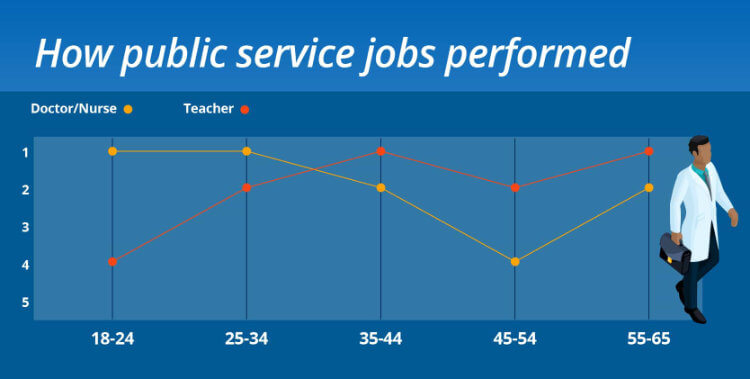
The desire to work in public service careers runs through every generation. Doctor/nurse and teacher made it into the top four in each of the five age brackets.


Dream jobs public service


Other, similarly caring or socially responsible jobs, such as veterinarian and lawyer, also feature prominently – making the top 10 in four of the five age ranges.


500 of our survey respondents are parents with children under-16. So, we asked them what their child’s dream job would be:


1stDoctor/Nurse
2ndPolice Officer
3rdVet
4thTeacher
5thFirefighter
6thTV Personality/Celeb
7thArtist
8thPro Sports Star
9thActor
10thScientist, eSports Player


Again, roles that entail some form of public service performed well, making up the entire top five. However, some digital or media-based roles are gaining traction.


eSports player again makes the top 10, confirming the emerging popularity of a role that wouldn’t have existed when older generations were in their childhood. Performing even stronger is TV personality/celebrity in 6th. For this, we also specified this could include a YouTube star, therefore including the role models that many younger generations now aspire to be.


The rise of digital technology and social media has formed a new type of celebrity. As children head for YouTube and video games such as Fortnite for entertainment, they search for idols that align with these interests. In an attempt to emulate them, the jobs of these idols are now finding their way to the top of the most aspirational roles for the youngest generations.


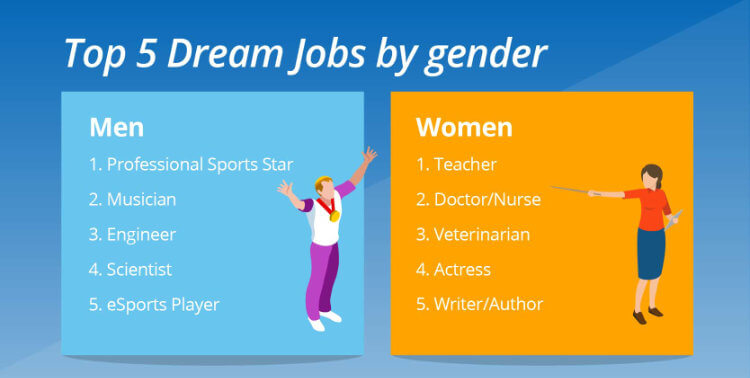
There were some significant differences in the aspirations of men and women during childhood.


Dream jobs by gender


We found that females were much more inclined to select caregiving, public service-related jobs – with teacher, doctor/nurse, and veterinarian making up the top three. There is a connection between this data and the gender breakdown of these industries. Teaching roles in the USA are overwhelmingly taken by females, whilst female graduates are higher in veterinary medicine than males.


The same can be said of some of the highest placed male dream jobs. Science and engineering is one of the most male-dominated industries of them all, and video gaming has long been stereotyped as a male-orientated past time.


These statistics say something about the differences between men and women, and how different upbringings influence what we want to do when we grow up.


But Most of Us Never Make It

We also asked respondents if they managed to achieve their childhood dream and make it to their ideal job. Just short of a quarter (24%) of people have at some stage been employed in their childhood dream job – including 10% that are right now. Nearly two-thirds (64%) of those that said they made it also said the job lived up to the expectations they placed on it during childhood.


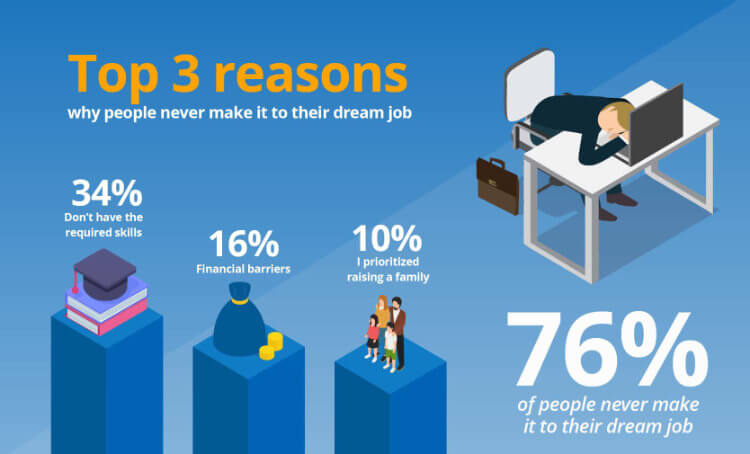
Of the remaining 76% that never made it, over a third (39%) say they regret not pursuing their aspirations further. Asked what they think the most significant factor is to never achieving their childhood dreams, 34% said that they simply “don’t have the required skill set or knowledge”.


Dream jobs reasons


Other significant factors include “financial constraints”, which 16% of respondents selected, and “I prioritized raising a family” (10%). The latter was much more popular among women, with 14% selecting it compared to just 3% of men.


Are We Happy in Our Careers?

One final area the survey touched upon is how happy people are on their current career path, be it their dream job or not.


A third of all respondents said they aren’t currently happy in their career, with a clear trend of unhappiness towards younger generations.


Over a third (39%) of those aged between 18-44 are currently not happy in their careers, 10 percentage points higher than those aged 45-65 (29%). The same trend occurred when we asked them if they wished they had grown up in a different generation to their own, and therefore been afforded different career options and opportunities.


Of 18-44 year-olds, 30% said they wished they had grown up in an older generation. For 45-65 year-olds, just 18% wished they could have taken advantage of the job opportunities a younger generation had.


The oldest of our respondents (55-65 year olds) were the most content, with 68% happy with their inherited generation. This is 11 percentage points higher than 18-24 year-olds (57%), and 15 more than 25-34 year-olds (53%).


It reflects well on American society that jobs that fundamentally care for people are being aspired to the most, and that doesn’t seem to be changing from generation to generation.


However, more Americans have college degrees than ever before. While this provides opportunities for more of the population, it means a steady increase in the competition for specialist positions. To adjust to the technological revolution and an increase in automation, our idea of the dream job may have to evolve to maximize our career prospects.