
Technology has transformed the way companies and their employees operate every day. While the benefits of a more connected world are numerous—we can do business with customers around the world, and they can communicate with us through 1800 numbers—could we benefit from occasionally switching off from the digital world?
Particularly since the start of the COVID-19 pandemic and the rapid rise in hybrid working and working from home, we have become more reliant on technology to work and communicate. But how has this affected us and could we benefit from switching off more regularly?
Here, we explore the growing concept of the “digital detox.” As digital technology further engrains itself into every aspect of our lives, how might we benefit by reducing our exposure when we leave the office or switch off our laptops at the end of the working day?
What Is a Digital Detox?
The term digital detox, which is now listed on dictionary.com, can come in whatever form the participant feels is necessary. A digital detox is the act of refraining from using digital or electronic devices for a certain period of time, with the intention of avoiding the distractions that come from always being connected.
Some examples include:
- A set time every day where all devices, such as laptops and smartphones, are switched off
- Not engaging in any work-related communications, such as email, outside of working hours
- Actively engaging more in conversations and interactions in the “physical” world and less in the “digital” world
- Logging out of social media accounts for prolonged periods to provide a break and combat overexposure to social media
- Avoiding “doomscrolling” through negative, often COVID-related, news stories online
Does Digital Affect Our Mental State?

Behind the concept of a digital detox is the idea that while technology makes our lives easier, it doesn’t necessarily make us happier. Studies that connect technology with a decline in well-being are beginning to add up.
In 2012, The University of Gothenburg did an extensive study on the effects of computer and smartphone usage and found that excessive use can be linked to stress, sleep disorders and depressive symptoms. For those who used both computers and mobile phones combined, the risk was amplified.
Research has also been conducted around smartphone addiction in college students. In 2015, for example, a study showed users had negative physiological and psychological symptoms, such as increased blood pressure, an increased heart rate, and anxiety. This suggested that, for this generation, a dependency had developed, and when the tech was removed, “withdrawal” symptoms occurred.
Sleep, and how technology can have a negative impact on it, is of particular interest for those looking at how technology changes our lives.
Ellen Wermter of Charlottesville Neurology and Sleep Medicine notes how waves of blue lights, prominent in mobile devices, are disrupting our sleep patterns:
“There is one biological phenomenon that will improve communication, creativity, productivity, endurance, reaction time, concentration, memory, mood, and more—and that is proper sleep.
One of the main influences of our sleep patterns is light, particularly that which we get through our phones, tablets and laptops, which are often close to our face and that many of us use late into the evening and even take into our bedrooms.”
Why is sleep so vital to workplace performance? A study from Hult International Business School showed that, due to a depreciation of skills such as communicating effectively, assessing risk and producing innovative solutions that come from a lack of sleep, organizations lose $2,280 a year per sleep-deprived employee.
A good night’s sleep can improve each of the following productivity boosters:
- Memory
- Creativity
- Energy levels
- Attention span
- Lower stress levels
As upcoming workplace generations instill technology even more deeply into their lives, these detrimental effects pose a significant problem for workplace productivity. So, how can companies address this?
How Can You Encourage Employees to Detox?
Some businesses are encouraging staff to cut down on technology at home and take regular breaks at the office as a means of boosting productivity during working hours.
Digital detoxing outside of work

Using technology to work in the office is one thing, but there can be drawbacks to technology when working remotely. Chady Tawil of Mozaico found a problem of this nature at his company:
“As we work within a fully remote team with staff located all around the world, instant messages and notifications from our productivity platform can be received literally 24 hours a day.”
Smartphones may allow us to always be connected with work, but here it led to employees unable to disconnect. In response, Tawil removed apps such as Trello and Slack from employees’ personal phones, allowing them to get some downtime outside of work.
German automotive company Daimler AG implemented a similar email-based solution in 2014. Dubbed the “Mail on Holiday” system, any emails sent to an employee while they were on vacation were automatically deleted, and details of who to contact were forwarded to the sender.
The policy intended to give employees an opportunity to enjoy their time away, promoting a healthier work/life balance so they could return to work free of stress and ready to hit the ground running again.
It’s not only individual businesses who are getting involved with digital detox initiatives. In France, the government intervened in 2016 by implementing the “right to disconnect” policy.
The measure was intended to tackle the “always-on” work culture. Companies with more than 50 workers were required to draw up guidelines around the use of email and work-related smartphone use outside of office hours. Employees could negotiate a total ban on sending emails outside of office hours.
Of course, with home and hybrid working now more commonplace than ever before, digital detoxing at home can be tricky. Health in Mind have some excellent recommendations for differentiating between work and spare time when working from home, which can be useful for employees:
- Have a routine: Work the same hours each day and take breaks at regular times. Try to avoid working late just because it’s easier to do so from home.
- Bookend your day: Have an activity, such as exercising, meditating, or taking a walk around the block, that you do immediately after work to tell your brain that working time is over.
- Have a defined desk space: While not everyone has the space for a separate room, or even desk, to work at, try and demarcate at least some space that you only use for work.
- Find purpose in your evenings: Enjoy your evenings and give yourself something outside of work to focus on. Anything from getting lost in a good book (or finally writing your own!) to DIY or gardening will help you switch off – and on the subject of switching off, make sure to do just that to your work phone.
Detoxing while at work
In addition to a home-based digital detox, an alternative is to offer a break from tech during work hours. Consider implementing some of the following work policies to further enhance productivity:
- Encourage regular breaks away from the computer screen
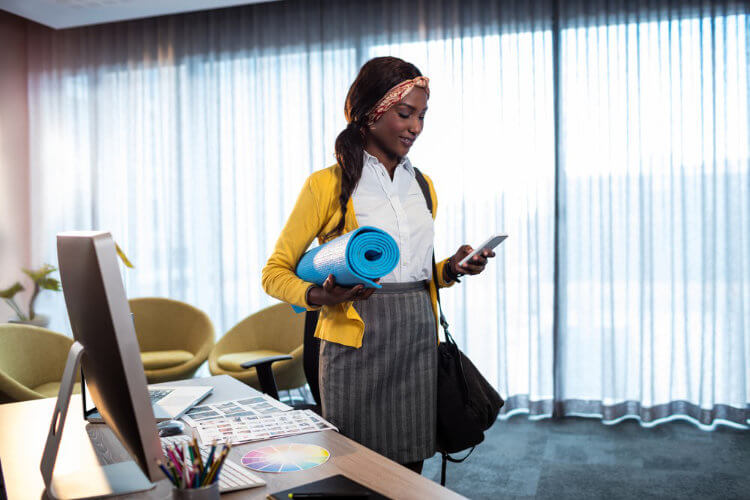
- Organize well-being or recreational classes (such as yoga) at lunch, helping employees to get away from their desks
- Have tech-free meetings, allowing staff to rely only on their interpersonal skills to communicate ideas
We spoke to businesses who have adopted workplace digital detox policies. One extreme example comes from Mexico-based travel comparison site El Mejor Trato, who has completely eliminated email from their workplace.
“Instant messaging apps and emails are our worst enemies,” VP of HR and Co-Founder of El Mejor Trato, Cristian Rennella told us. “The key for employees to effectively manage workplace stress and achieve full productivity is to learn how to handle instant messaging apps and emails.”
By “handling,” Rennella meant completely remove. Studies have found that workers spend almost 30% of their day with emails—so El Mejor Trato took the drastic step of removing them altogether.
Another example comes from TheAdvisorCoach.com. Their CEO, James Pollard, found technology was negatively impacting staff:
“Due to the nature of the business, a lot of people work from home and there are a lot of Skype calls, Zoom webinars, email support, live chat, my employees are glued to their devices all day. I noticed that people seemed a little burned out or sluggish around 2 pm every day.”
To counter the problem, Pollard started a new policy where staff were to detach themselves from all technology and do whatever they pleased between 1:30 p.m. and 2:30 p.m. every day.
How You And Your Employees Could Benefit

We’ve seen how a reduction in tech in our lives can help us to lower stress, increase creativity and, ultimately, improve productivity levels—and business leaders are already onboard.
Gianluca Boncompagni, CEO at Massage Tables Pro, took a digital detox and found it beneficial personally and professionally:
“Even during my days off, I’m answering emails, putting fires off, or figuring out how to make a better profit margin. Needless to say, stress levels have affected me, resulting in a bad quality of sleep, or trouble not thinking about work.”
But thanks to a digital detox, Boncompagni has reduced those negative effects:
“After five days of not touching my laptop, and putting my phone on silent, I had the most relaxing long weekend probably of my life. I came back to work the next week with renewed energy, a clearer mind, and fresh ideas.
After that day, every two months I take a small detox to charge my batteries and get things going again.”
And in each of the three detox initiatives above, business leaders also found positive results amongst staff.
“After eliminating instant messaging and emails, our biannual internal survey found stress levels of our employees decrease by 47%,” Rennella commented.
Pollard also said his workers at TheAdvisorCoach.com reacted positively to the change:
“I’ve found that my end of day productivity has greatly increased. We just set up an auto-responder telling all my customers that we will return at 2:30. Business has not been negatively impacted.”
After his removal of work-related apps from smartphones, Tawil also saw a boost in productivity at Mozaico:
“We have seen a more concentrated period of work within normal working hours for each member of the team. With that, higher levels of productivity and improvements reported in work-related stress levels”.
Tips on How to Digital Detox
Here are four tips to help start a digital detox for your business:
- Consider an allowance: Give yourself a daily “tech-free” allowance where you can switch off devices and email and remove yourself from everything that comes with it
- Focus on sleep: A good night’s sleep is key to improving each negative aspect tech brings with it; make a more productive and happier you by switching off your devices at least 30 minutes before you attempt to go to sleep
- Set up a detox buddy system: You might find it easier if you have someone else to bounce digital detox ideas off of
- Leave your gadget behind for a day: Try a day where you use no technology whatsoever and monitor your mood and well-being.
Have you undergone a digital detox? Let us know how it’s going on Twitter @TFFSocial